Students co-shaping assessment: the Studierendenrat at Leuphana University Lüneburg
A student council of 23 randomly selected students deliberated on the Transformation module and proposed staged submissions, learning checks and alternative examination formats - moving assessment toward a companion of the learning process.
The practice
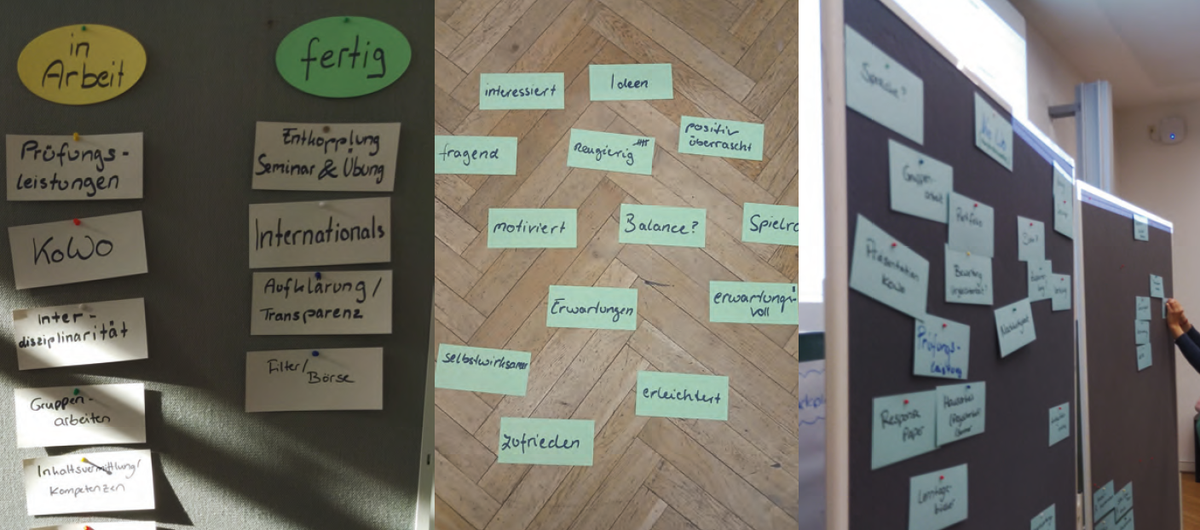
The Leuphana Semester is a shared first semester that all undergraduate students at Leuphana University Lüneburg attend. With the recent restructuring of its Transformation module, the university piloted a new format for feedback on teaching that goes beyond traditional course evaluations and formal quality circles: a student council (Studierendenrat) modelled on the principle of citizens’ assemblies. For the pilot in 2025/26, 23 students were selected by lot under diversity criteria (faculty, semester, gender) so as to represent the student body in miniature. Across five professionally moderated and scientifically accompanied sessions, participants deliberated on the module’s content, structure, and teaching and assessment formats, and condensed their perspectives into a set of shared recommendations, published as a final report (“Gutachten”). Assessment was at the center of these deliberations: among the council’s twelve recommendations, students proposed staged submission of the module’s assessed work with formative feedback on each stage, voluntary short learning checks accompanying the lecture (rewarded with bonus points), a closer coupling of the graded portfolio to lecture content, and alternative examination formats. Taken together, these proposals move assessment from a concluding verdict toward a companion of the learning process, and they show how students can become co-designers of the formats by which they are assessed. The example also reflects critical conditions for improved student participation, as participants were compensated for their engagement and the module team committed to responding transparently to each recommendation at the start of the following academic year (Leuphana University Lüneburg, 2026).
The landscape pressures it speaks to
The council responds to skepticism about the relevance of higher education ( ⇓ ) by treating student perspectives as a design factor in the development of teaching and assessment, and to the crisis of democratic culture ( ⇓ ) by letting students experience deliberation, consensus-building and institutional responsiveness first-hand; its diversity-sensitive selection also addresses the concern that participation formats reach only the already privileged ( ⇓ ). The crack in the regime practice ( ◊ ) it exposes is the standard evaluation regime: questionnaire-based course evaluations with fluctuating, self-selected participation, little exchange among students, and feedback that rarely reaches those responsible for program development in a form they can act on. Behind it lies an assessment regime that students experience as terminal grading rather than as support for their learning, and in whose formats they have no say.
Pathways for scaling
- Anchoring ( ⇑ ): The College leadership expressed its interest in continuing with the council as a standing element of quality development; stable funding lines and a defined place in quality-assurance procedures would consolidate this.
- Translation ( ⇑ ): Casting the outcome as a publicly available report with a documented institutional response translates student deliberation into a format that governance actors can process.
- Aggregation ( ⇑ ): The format lends itself to transfer to other large modules and programs, accompanied by research on its effects on participation quality and teaching development.
References:
Leuphana University Lüneburg (2026). InnoTransform – Studierendengutachten: Empfehlungen zur Weiterentwicklung des Transformationsmoduls. Lüneburg. See also the Student Council page on this site.