



SusTelling E-Learning | Module 1: What is SusTelling?
What turns a story about sustainability into SusTelling, and when does it work? Using the case of the initiative “clever”, Module 1 introduces the characteristics of SusTelling, places it within sustainability communication and asks about its potential and limits.
SusTelling E-Learning · Storytelling for Sustainability
- Module
- 1 of 3
- Sections
- 11
- Exercises
- 5
- Audio
- 16
- Licence
- CC BY-NC-SA 4.0
The “clever” case study: Introduction
“clever” – a case study
Anna is the head of communications of a three-member newly founded initiative called “clever”. This initiative sees itself as a sustainable entrepreneurial business.
“clever” offers unpackaged food so that customers can use their own containers to take home their purchases. A new store is opening soon, and Anna needs to communicate this event to the public. “This would be a good opportunity to educate people about the background of our initiative and how it differs from other supermarkets – it could also encourage others to launch similar sustainability marketing projects!” thinks Anna. She contacts some media representatives and manages to get the local newspaper to publish a short news item. Anna is thrilled that the local newspaper will reach many people in the region who have shown little interest in unpackaged shopping and might be won over. That very evening, she receives a draft text from the editors. After reading it, Anna is disappointed – she would have liked a much livelier article. Anna decides to take matters into her own hands and use storytelling to create a story that conveys the underlying sustainability ideas behind food and packaging to customers in a more appealing way.
Before you start with the first module, find out more about the sales concept “clever” and what sustainable entrepreneurial businesses are and what sustainable consumption means.
The sales concept
The “clever” sales concept is based on a self-service principle. Consumers fill the food themselves into reusable containers they have brought with them or have been provided by the store. The initiative takes this idea one step further because by using mostly local suppliers transport routes are kept short and the seasonal offerings of fruits and vegetables support local producers and suppliers and reduce the CO2 emissions for delivery and storage.
Sustainable entrepreneurial businesses
What these initiatives have in common is that their actions are not solely based on making a profit. Prices are negotiated to benefit everyone, and there should be close and direct relationships between producers and distributors. The overall goal of such companies is to advance environmental and social change in the trade and sale of products. Such initiatives seek to build trust between producers, buyers and consumers.
Sustainable consumption
We define sustainable consumption as actions by individuals involving the purchase, use and disposal of goods and services to satisfy one’s own needs in basic areas of life such as food, clothing, mobility and leisure. These actions are undertaken without harming the ecological and socioeconomic bases of other people – now or in the future – to meet their needs.
The “clever” case study: The editor’s draft
Anna reads through the local editor’s text again and thinks about what exactly bothers her and what she would like to do differently in her story. The first thing she notices is the matter-of-fact tone of the article and how full of information it is. She believes readers would learn about the store opening, but hardly anything about her initiative.
This would reach only a few people who weren’t already familiar with the concept. It would also make it difficult to motivate others to undertake similar projects. Anna realizes that the story she wants to write should achieve the following goals:
- The story should interest people who know little about alternative forms of consumption.
- People who are already interested in the topic should be motivated by this successful store opening to take part in similar projects.
- The story should explain the concept of their initiative and its background in an understandable way.
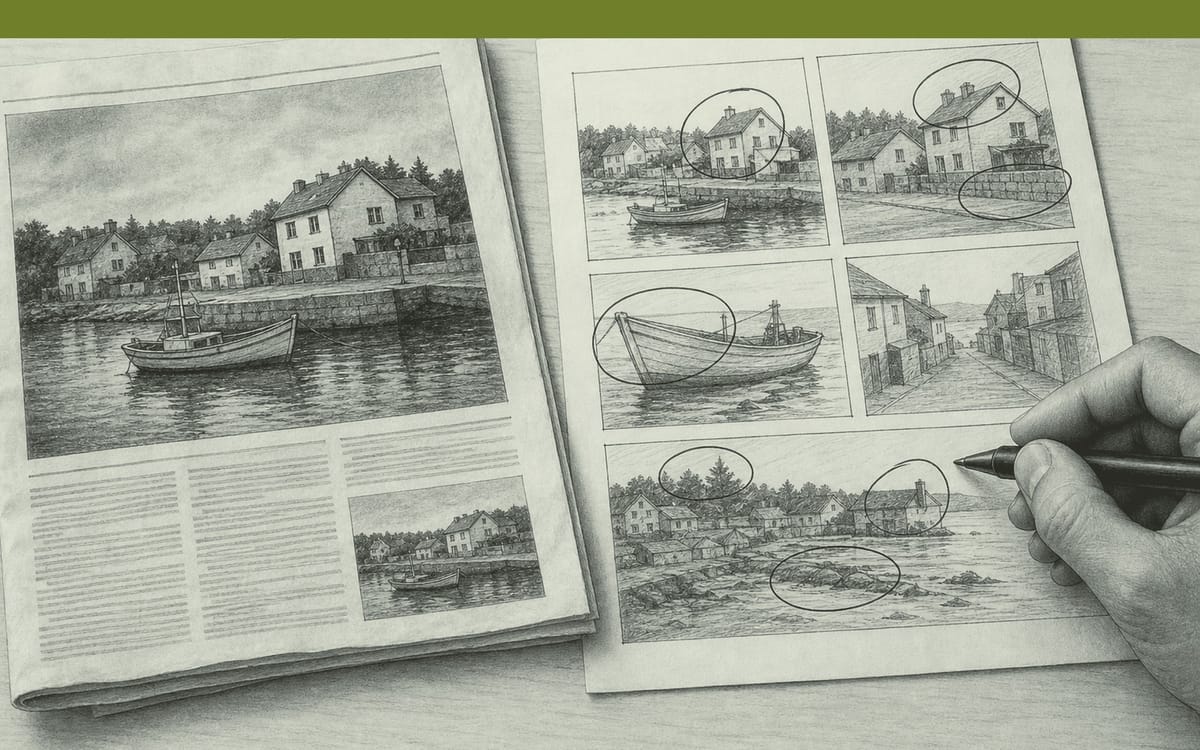
The article
Message from the local editor:
Comment: Why is this no SusTelling?
What is SusTelling?
We understand storytelling as a practice in which content (e.g. facts, information) is put into a narrative form that we call a “story”. SusTelling, or storytelling in sustainability communication, is the telling of a story with the intention of promoting sustainable development.
SusTelling is characterized by design characteristics in which the narrative is embedded. We distinguish between inner and outer characteristics. In the following you will learn more about these characteristics:
Inner characteristics of storytelling
Storytelling in sustainability communication, or SusTelling, is the telling of a story
- with a clear arrangement of characters and storyline Plot,
- focusing on characters and their experiences Personalization and
- that presents conflicts, developments and resolutions Dramaturgy,
- that has a recognizable beginning, middle and end Chronology,
- that gives information about the temporal, spatial and cultural setting Context,
- that builds up an inner arc of tension through stylistic devices Stylistics,
- with a certain mood Tonality
- and has a more or less interactive and immersive way of presentation Modality,
to have an educative effect on recipients Educational outcome and to promote change towards sustainability Sustainability outcome.
SusTelling has an educational effect when it strengthens people’s ability for critical reflection and self-emancipation. SusTelling has a direct sustainability impact when it helps to change people’s behavior or actions so that they are more in line with certain sustainability goals.
External characteristics of sustelling
SusTelling…
Setting
… always takes place in a social context, that is, within the context of a professional field such as journalism, science communication or corporate communication/public relations. The communication goal also varies with the social context.
Medium
… uses a communication channel (e.g., video, podcast, text or image series) to convey the narrative.
Theme
… is dedicated to questions about a specific subject area, such as sustainable nutrition, mobility, clothing or tourism.
The film “Rang-tan!”
External characteristics of storytelling
Task
External characteristics of SusTelling
Internal characteristics of storytelling
TASK
Inner characteristics of SusTelling
What is sustainability communication?
“Sustainability communication is a process of understanding that is concerned with future-proofing social development, centered on the guiding principle of sustainable development” (Michelsen, 2007).
There are some difficulties associated with communicating sustainability issues, challenges and goals. These are evident in various fields of practice such as corporate communication, journalism and science communication, and are presented in more detail below.
Learn more
Godemann, J., & Michelsen, G. (Eds.). (2011). Sustainability Communication: Interdisciplinary Perspectives and Theoretical Foundation. Springer.
Challenges in sustainability communication
Here you’ll find more information about the challenges of communicating sustainability issues. An important task of sustainability communication is …
An important task of sustainability communication is …
… to make emerging knowledge from sustainability research available to the public so they (further) develop a sensitivity for social and ecological problems.
Sustainable development aims …
… to ensure that current and future generations can meet their needs without exceeding the ecological limits of the planet.
When we want to report on sustainability issues …
… we often face the problem that we are talking about challenges that lie on different scales of time and space. What we do today may have an impact on what happens in completely different places and in the future. In short, we are dealing with complex interactions that are not easy to communicate.
The interrelationships between levels and systems are …
… dynamic, and so the consequences of our current actions can only be estimated with uncertainty.
These dynamic and complex interrelationships …
… need to be communicated in an understandable way so that as many people as possible have the chance to understand them and to incorporate this knowledge into their decision-making processes.
What is the potential of SusTelling?
- Narratives are better understood than non-narratives. [1],[2]
- Narratives allow complex relationships to be made more vivid and understandable. [3]
- Narratives can present moral conflicts in detail. [4]
- Narratives are suitable for presenting everyday experiences from other lives in order to make them real for the audience. [5]
Learn more
[1] See Kintsch, W. (1980). Learning from text, levels of comprehension, or: Why anyone would read a story anyway. Poetics, 9(1-3), 87-98. doi: 10.1016/0304-422X(80)90013-3.
[2] See Johnson-Laird, P. N. (1983). Mental models: Towards a cognitive science of language, inference, and consciousness (No. 6). Harvard University Press.
[3] See Vervoort, J. M. et al. (2014). A sense of change: media designers and artists communicating about complexity in social-ecological systems. Ecology and Society, 19(3). DOI: 10.5751/ES-06613-190310
[4] See Graesser, A. C., Olde, B., & Klettke, B.. (2002). How does the mind construct and represent stories. Narrative impact: Social and Cognitive Foundations, 229-262.
[5] See O’Connell, K., Keys, B., & Storksdieck, M. (2018). Getting to know guerrilla science participants: evaluating unexpected and unusual science encounters. Technical Report. Corvallis, OR: Oregon State University, Retrieved from: https://stem.oregonstate.edu/sites/stem.oregonstate.edu/files/Guerilla-Science-Final.pdf
What are the disadvantages of SusTelling?
- Narratives may oversimplify complex issues. [6], [7]
- Narratives may be subjective in nature. [8]
Learn more
[6] See Bond, A. J., & Morrison-Saunders, A. (2011). Re-evaluating sustainability assessment: aligning the vision and the practice. Environmental Impact Assessment Review, 31(1), 1-7. DOI: 10.1016/j.eiar.2010.01.007;
[7] See Frame, B., & Newton, B. (2007). Promoting sustainability through social marketing: examples from New Zealand. International Journal of Consumer Studies, 31(6), 571-581. DOI: 10.1111/j.1470-6431.2007.00600.x.
[8] See Hausberg, K.-P. (2014, June). Sustainable knowledge transfer through storytelling. Conference of the UNESCO World Heritage Sites Germany e. V., Maulbronn.
SusTelling E-Learning, SusTelling project team (2020). Licence: CC BY-NC-SA 4.0, unless stated otherwise. Funded by the German Federal Environmental Foundation (DBU).
The audio recordings were re-recorded in 2026 with AI voices (OpenAI), based on the original scripts.