Having ownership: students shape teaching at the Eberswalde University for Sustainable Development
At HNEE, Master's students design transdisciplinary micro-projects and mentor Bachelor's students in a university-wide introductory course on sustainable development.
The practice
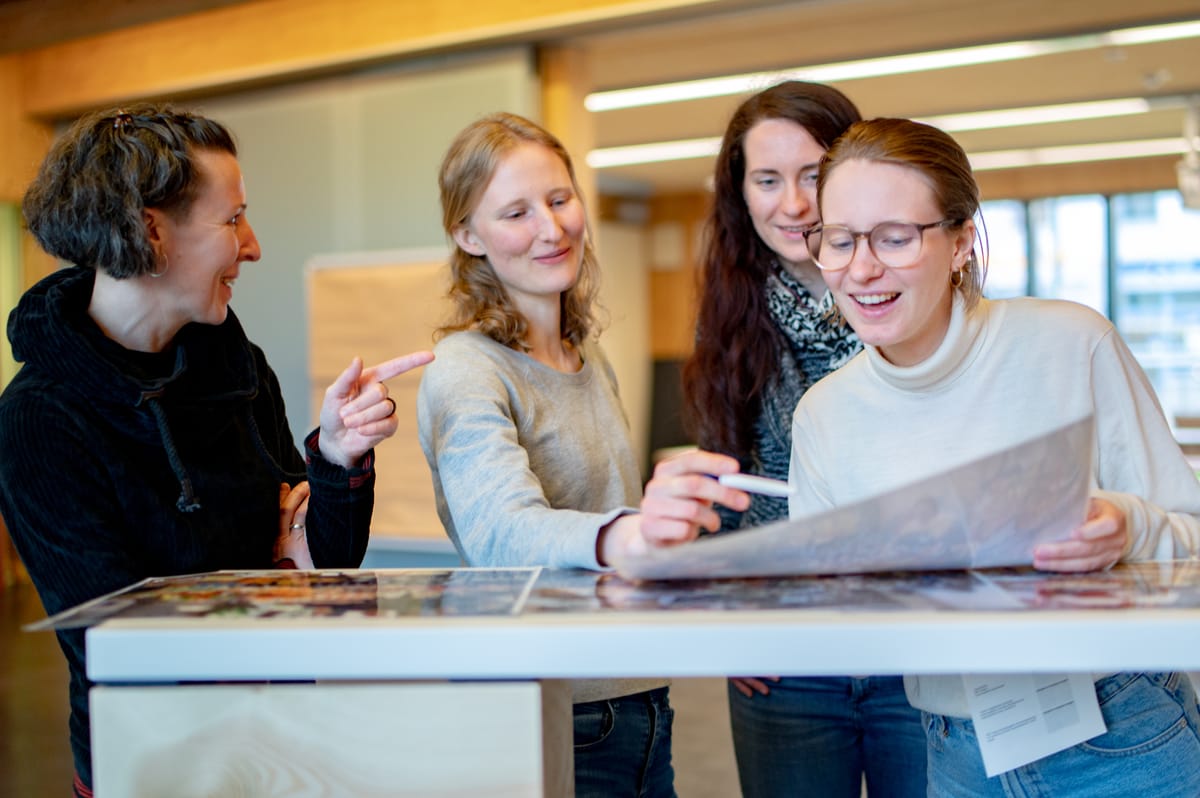
The module ‘Methods and Concepts of Sustainable Development’, developed at the Eberswalde University for Sustainable Development (HNEE) and awarded the Brandenburg State Teaching Prize for Future Skills, demonstrates how student participation can be successfully achieved. As part of the module, Master students develop transdisciplinary micro-projects on which all HNEE Bachelor’s students work in small interdisciplinary groups during a university-wide introductory course on sustainable development. Master students support Bachelor students throughout the learning process and act as mentors. The teaching approach is competence-oriented and situated within the context of HESD.
The module will continue to be developed and will be managed almost entirely by Master students. Master students who have already finished the module teach other Master students, who in turn will serve as mentors for Bachelor students.
The landscape pressures it speaks to
The module addresses two of the pressures identified. Skepticism ( ⇓ ) about higher education’s relevance is countered by giving students responsibility for their individual learning process and enabling them to take responsibility for other students as a mentor. And the erosion of trust in public institutions ( ⇓ ) is addressed on a small scale through the delegation of responsibility for learning processes within the community and the associated negotiation processes. It changes the hierarchies and power dynamics between teachers and students. The crack in the regime practice it exposes is the treatment of participation as consultation ( ◊ ): students are invited to give input on teaching, while the decision about what is taught and how stays with faculty, and the skills and experiences of diverse and qualified students go unused.
Pathways for scaling
To lift this format from the niche status to the regime, targeted efforts are needed in the following areas:
- Anchoring ( ⇑ ): teaching regulations allow students to act as teachers under certain circumstances. This is currently still subject to a case-by-case review and should be expanded further.
- Coalition-building ( ⇑ ): structures should be co-developed with students, teaching-development units (graduate schools) and quality-enhancement offices. They are key partners in fostering the co-design of teaching practices, living labs and play an important role in co-designing curricula as learning journey.
- Aggregation ( ⇑ ): At HNEE, there are several teaching formats that have been significantly designed and implemented by students (“Projektwerkstätten”, methodological mentoring in university-wide introductory course on sustainable development, service learning). These need to be made more visible and structured for the university community so that everyone can benefit from them. An award or prize could serve as a strong argument in this regard.