"Neglectable": The Hidden Mental Trick Behind Our Dairy Consumption

In a new publication led by Sarah Kunze and Bernice Bovenkerk from Wageningen University, we shed light on a previously underexplored dimension of ethical consumer behavior: the "dairy paradox."
While meat consumption has long been scrutinized for its environmental and ethical costs, dairy often perceived as a more benign alternative also contributes significantly to greenhouse gas emissions and animal suffering. In this exploratory paper that is based on the Master thesis by the first author Sarah Kunze, we investigate how consumers reconcile their moral concerns with continued dairy consumption, using focus groups to identify the psychological strategies used to manage cognitive dissonance. We find that although dairy is generally framed more positively than meat, the coping mechanisms employed are strikingly similar—yet distinct enough to warrant a new category: neglectable. This term captures the idea that dairy’s harms are downplayed as unintentional, overwhelming, or simply too distant to confront.
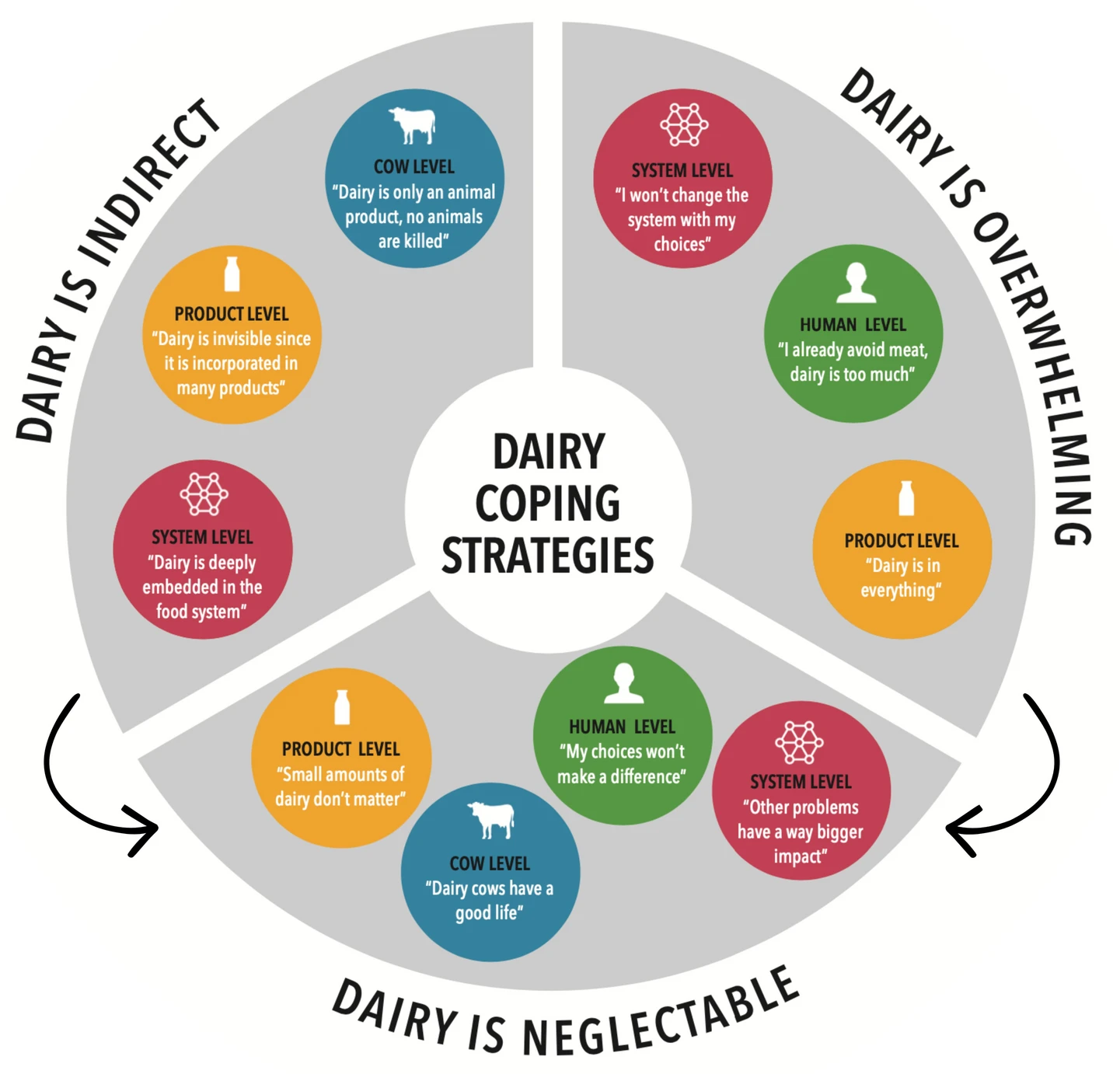
We propose expanding the well-known "four Ns" (natural, normal, necessary, nice) used to justify meat consumption to include a fifth: neglectable, specifically for dairy. This reframing not only highlights the moral complexity of dairy but also offers a new lens for understanding how consumers navigate ethical contradictions in their diets.
Paper Abstract:
Dairy is the second largest greenhouse gas emitter in animal agriculture and requires the killing of animals. Most people wish to avoid harming animals and the climate but also consume meat. Consumers subconsciously use coping strategies to reduce cognitive dissonance caused by this meat paradox. But is there also a dairy paradox? For this exploratory study, we used focus groups to investigate cognitive dissonance and coping strategies related to dairy consumption and compared these to coping strategies around meat. We found that dairy is framed much more positively than meat. However, the types of dairy-related coping strategies strongly overlap with those for meat. We conclude that dairy-related cognitive dissonance occurs, identify the dairy paradox, and three dairy-specific coping strategies: dairy is indirect, overwhelming, and, in summary, neglectable. We suggest adding a fifth N to the Ns of justification of meat consumption: natural, normal, necessary, nice; specifically for dairy: neglectable.
Bibliographic reference:
Kunze, S., Bovenkerk, B., & Fischer, D. (2026). Beyond Natural, Normal, Necessary, Nice: Introducing “Neglectable” as a Distinct Coping Strategy for the Dairy Paradox. Food Ethics, 11(1). https://doi.org/10.1007/s41055-026-00214-3