UNESCO Chair Lecture Series: Aaron Redman and Caleb Mandikonza on “Assessment in Education for Sustainable Development: History and Future Directions”
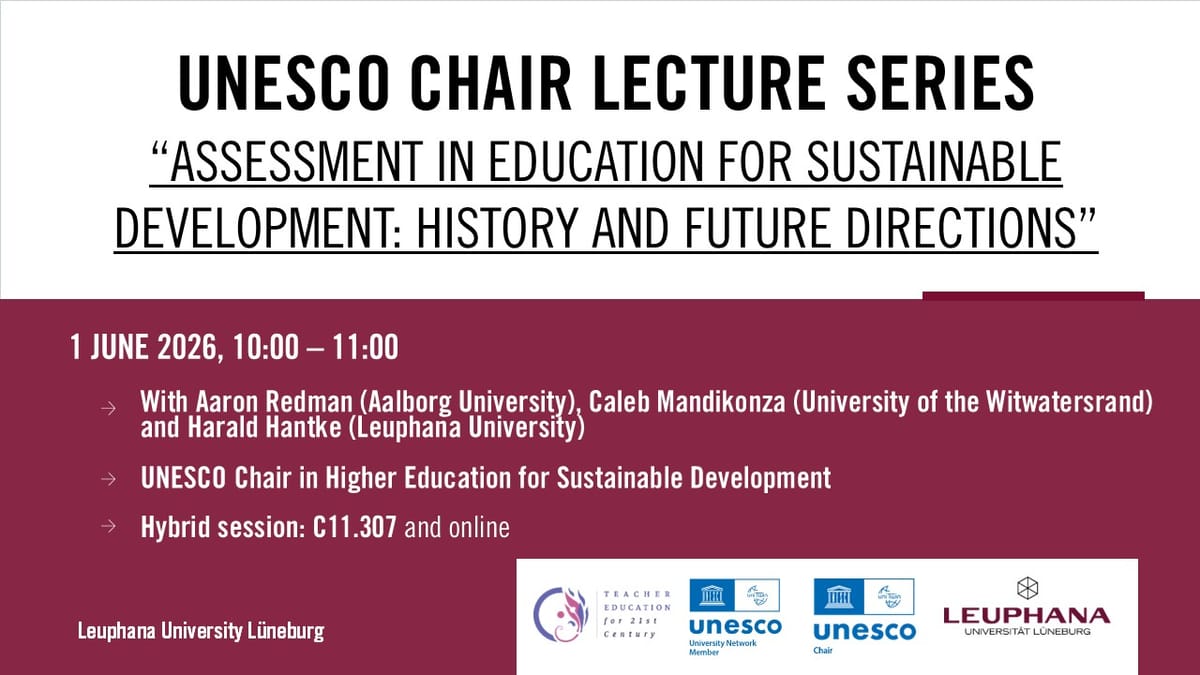
The UNESCO Chair in Higher Education for Sustainable Development at Leuphana University Lüneburg and SETRI is happy to share a recording of the first event in its new UNESCO Chair Lecture Series on assessment in ESD.
While Education for Sustainable Development (ESD) has made substantial progress over the decades of its existence, it is only in the last few years that ESD scholars and practitioners have begun to turn their focus to the critical topic of assessment. On June 1, 2026, Dr. Aaron Redman (Aalborg University, Denmark) and Dr. Caleb Mandikonza (University of the Witwatersrand, South Africa) joined us for an insightful exploration of the shifting landscape of assessment in ESD: Aaron Redman traced the history of assessment of ESD up into the present, including deeper insights into several projects he has been involved with in the past and currently with UNESCO's Transforming Futures and GreenEdTech at Aalborg University, while Caleb Mandikonza discussed the Assessment of Significant Learning (ASL) as a more robust, appropriate, and inclusive framework for assessing various dimensions of learning, especially in the context of transformative learning.
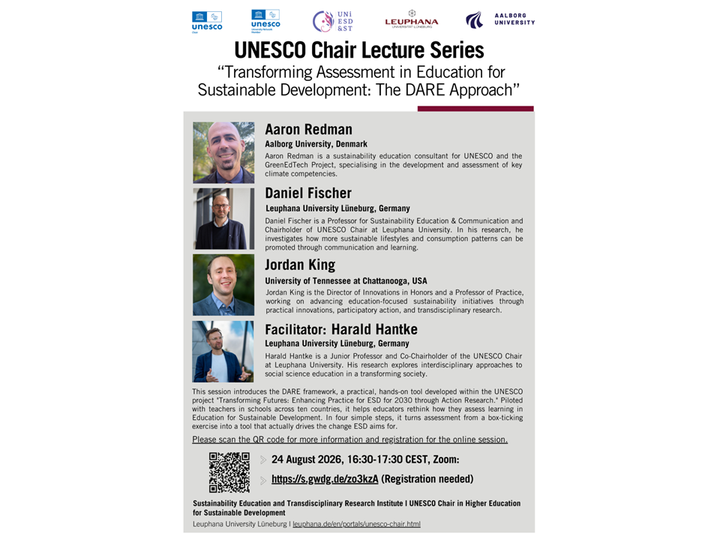
Moderated by Prof. Dr. Harald Hantke, the session concluded with a fruitful panel discussion on the future of measuring transformative learning.
You may watch the recording of the session below or by following this link.
About speakers
Dr. Aaron Redman (Aalborg University, Denmark) is a Sustainability, Climate, and Education expert and consultant. In 2020 he completed his PhD in Sustainability from Arizona State University (ASU). Aaron's dissertation focused on clarifying a framework of key competencies in sustainability and how to assess these competencies. Currently he is applying his expertise in sustainability assessment both on a recent consultancy for UNESCO as well as for the GreenEdTech Project led by Aalborg University in Denmark where Aaron is leading the assessment team. Aaron has recently joined the Sustainability Education Accreditation Commission (SEAC), an exciting new initiative built around operationalising the key competencies.
Dr. Caleb Mandikonza (University of the Witwatersrand, South Africa) is actively involved in cultural heritage knowledge relevant transformative ESD Assessment research and practice. He has a long history of working in ESD teacher education. Presently he is working at the University of the Witwatersrand in Science and ESD Education. His research focuses on indigenous knowledge, ESD and science education, transformative learning and change project approaches to teacher’s agency and capabilities. He holds a PhD in Environmental Education from Rhodes University.
Prof. Dr. Harald Hantke (Leuphana University Lüneburg, Germany) is a Junior Professor and Co-Chairholder of the UNESCO Chair at Leuphana University. His research explores interdisciplinary approaches to social science education in a transforming society.
About the UNESCO Chair Lecture Series
The UNESCO Chair Lecture Series, hosted by the UNESCO Chair in Higher Education for Sustainable Development at Leuphana University Lüneburg, was launched in the winter semester of 2025. It builds on and continues the legacy of earlier dialogue formats at our department, including the Institute for Sustainable Development and Learning’s series “In Conversation with …” and the UNESCO Chair’s “Rethinking Higher Education” series.
In this series, we bring together scholars from around the world to share their research and diverse perspectives on sustainability and Education for Sustainable Development (ESD). Designed as a hybrid format, the lectures offer a space for dialogue, exchange of ideas, and critical reflection on the role of higher education in shaping sustainable futures.
Should you have any questions, do not hesitate to contact us at unescochair@leuphana.de