Socio-economic Issues Are Gaining the Upper Hand: Key Findings from the Greenpeace Sustainability Barometer 2025
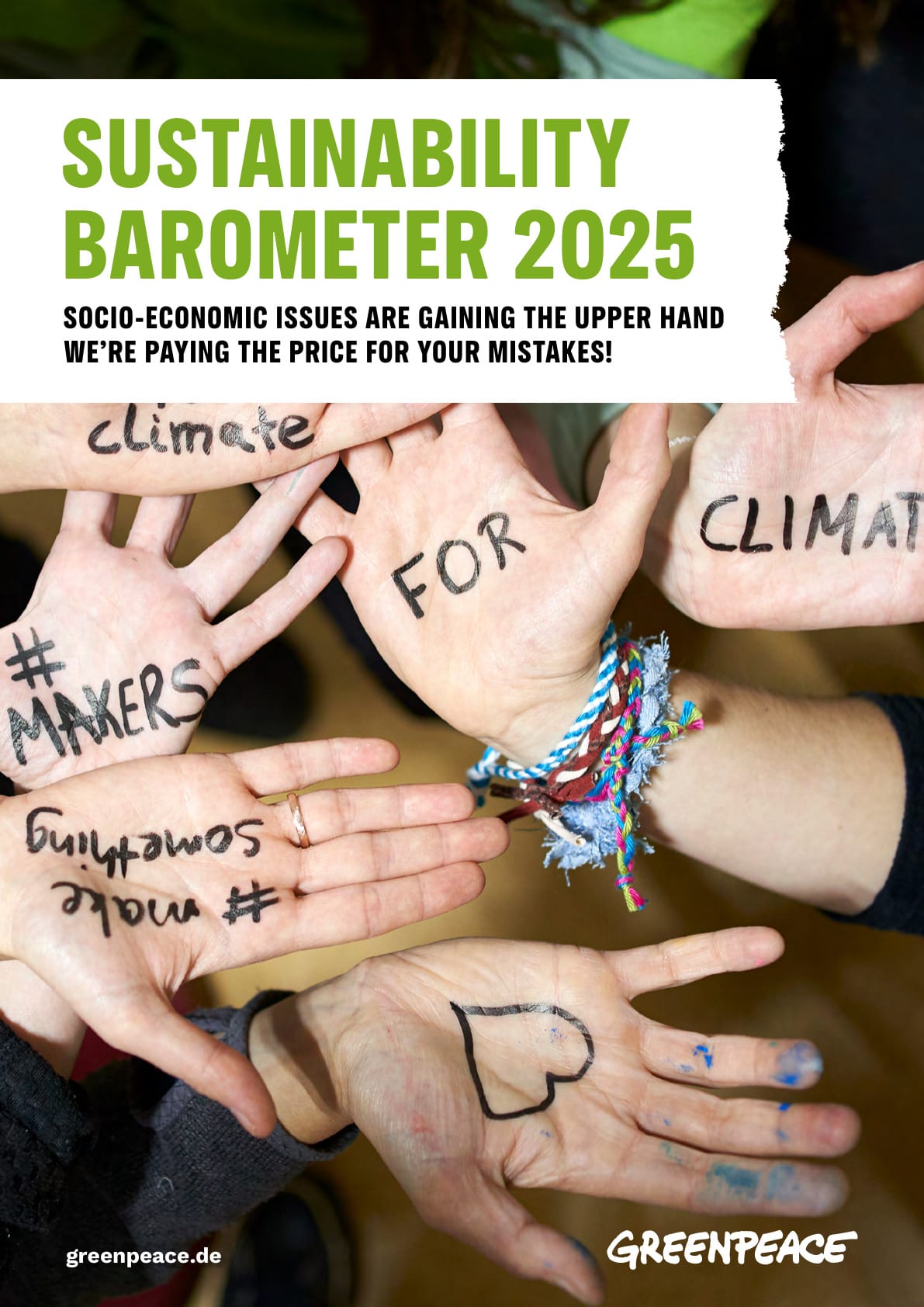
A new study published in June 2026 presents the central findings of the Greenpeace Sustainability Barometer 2025, the fourth wave of a representative survey of young people's sustainability awareness in Germany since 2011. Daniel Fischer (Leuphana University Lüneburg) co-authors the summary together with Matthias Barth, Sonja Geiger, and Lisa Sophie Walsleben (all Eberswalde University for Sustainable Development) and Marie Weiß (Leuphana University Lüneburg).
In June 2025, the ARIS polling institute surveyed 1,506 young people between 15 and 24 years old across Germany. The study is a collaboration between Greenpeace Germany, the Eberswalde University for Sustainable Development (HNEE), and Leuphana University Lüneburg.
Key findings at a glance:
- Socio-economic issues are gaining ground. "Cost of living" enters the top three most important concerns with nearly 30 % of mentions. "Environmental protection and climate change" loses 12 % compared with 2021 but remains in the top four. A new item, "democracy (in crisis)", is named as important by 16.6 % of respondents.
- Generational tension and political disillusionment. Around 70 % feel let down by politicians when it comes to environmental issues. Over 80 % agree that future generations are being made to pay for the mistakes of older ones. The current governing parties are seen as ill-equipped to tackle sustainability effectively (CDU/CSU 9 %, SPD 6.6 %).
- Education as a driver — yet uneven in implementation. Between 61 % (higher education) and 91.5 % (general schools) of respondents have engaged with sustainability in their educational settings; around 50 % more schools include the topic compared with 2011. The Whole School Approach has become an established concept, yet fewer than half see sustainability as actually practised across their institution.
- Perception of climate injustice. About half of respondents consider the unequal distribution of CO₂ emissions — with the carbon footprint of the top 1 % being roughly 15 times higher than that of the bottom 50 % — to be unfair or very unfair.
The authors draw a sobering conclusion: when major socio-economic and ecological challenges remain unaddressed due to a lack of political will or populist negligence, young people's perception of political and institutional failure is likely to be reinforced, eroding trust, fostering resignation, and ultimately harming democracy.
Paper Abstract:
Most young people feel let down by politicians when it comes to environmental and climate issues. Generation Z now regularly engages with sustainability, education for sustainable development, and the Sustainable Development Goals (SDGs) — at school, in vocational training, and at institutions of higher education. Yet instead of inspiring hope, this growing engagement increasingly leads to disappointment and anxiety. What particularly angers young people is the perception that high earners are responsible for a disproportionate share of CO₂ emissions. At the same time, younger generations are left to bear the consequences. Among those surveyed, there is no longer any doubt: "We have to pay the price for your mistakes" has become a bitter certainty. These findings come from the new Greenpeace Sustainability Barometer 2025.
Bibliographic reference:
Kress, D., Geiger, S., Walsleben, L. S., Weiß, M., Barth, M. & Fischer, D. (2026). Sustainability Barometer 2025. Socio-economic Issues Are Gaining the Upper Hand — We're paying the price for your mistakes! Hamburg: Greenpeace e.V. Available at: greenpeace.de/bildungsmaterial/Greenpeace Youth Study 2025.pdf