Better After the Shock? What Antifragility Can Offer Sustainability Science
In a new publication led by Philip Arthur (Arizona State University), together with C. Tyler DesRoches (Arizona State University) and Henrik Thorén (Lund University), we explore what the concept of antifragility can offer sustainability science. The Overview article, published in Sustainability Science, applies the concept to a core question of the field: how to satisfy human needs in a world marked by disruption.
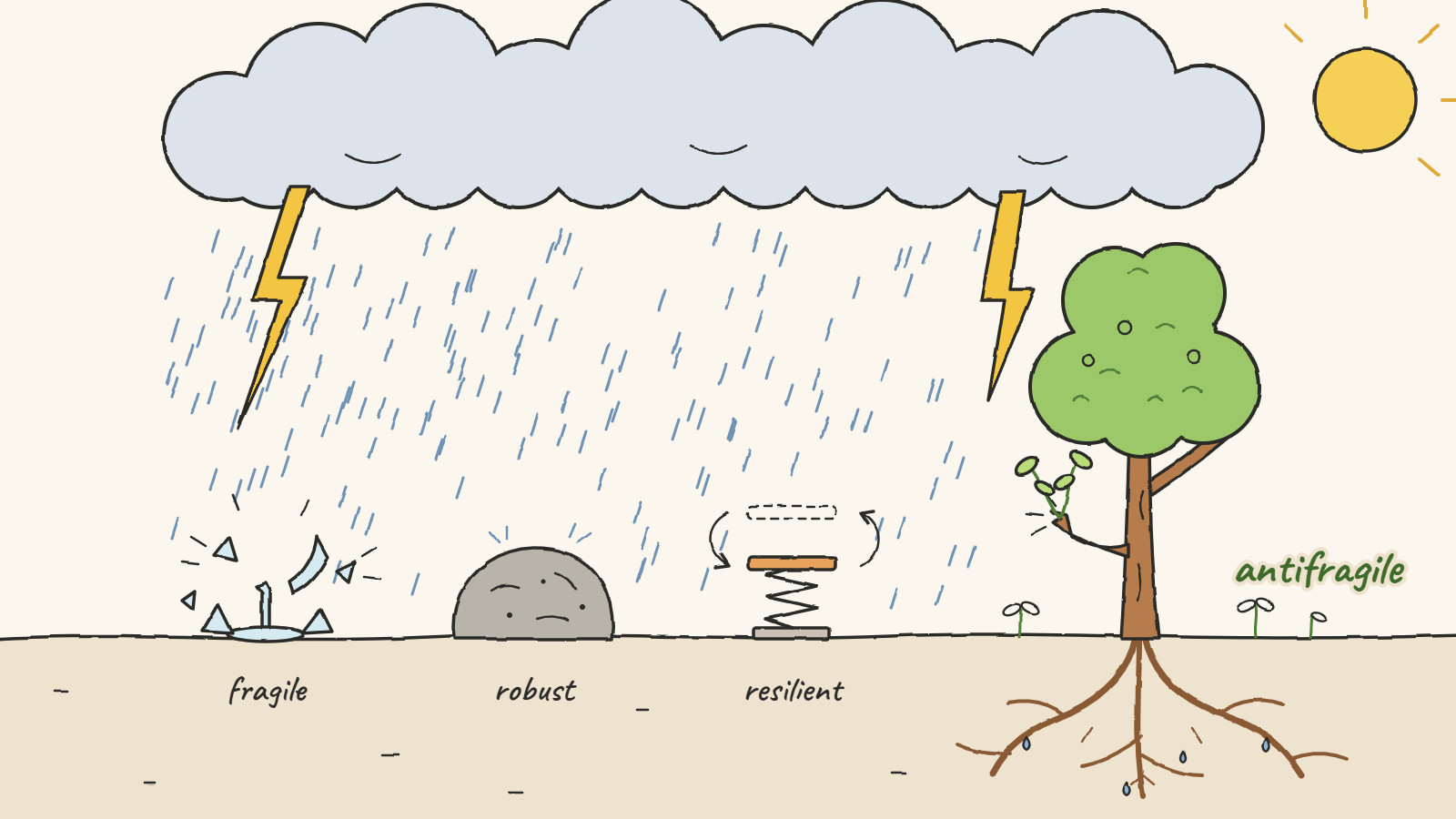
The concept itself comes from Nassim Nicholas Taleb. In his book Antifragile: Things That Gain from Disorder (2012), Taleb describes systems that do more than withstand shocks: they grow stronger because of them. He sets antifragility apart from robustness, where things endure stress without changing, and from resilience, where things recover and return to a previous state. The immune system is his paradigm example. Researchers have since begun to take up the idea in risk analysis, organizational studies and human–environment research, and our article builds on this work.
What we add is the connection to human needs as a perspective from sustainability science. Building on Manfred Max-Neef's distinction between needs and the means by which they are satisfied, we argue that resilience, in some of its uses, aims at restoring a prior state that may be neither reachable nor worth returning to. We position antifragility as a complement to resilience and follow three features that Taleb and subsequent authors associate with antifragile systems: decentralization, optionality and a proactive approach to stressors. We then trace these features in cases from water, energy and food systems, among them the Dutch Room for the River program, China's Sponge City Initiative, community microgrids in Puerto Rico and push–pull cropping in sub-Saharan Africa.
The cases also show the costs: farmers whose land was turned into floodplain, communities at the edge of the grid, households that cannot afford their own solar storage. The article therefore argues for ethical guardrails around antifragile strategies and closes with a research agenda for making post-shock improvement, and the distribution of its costs, measurable.
Paper Abstract:
Calls to make ecological systems, organizations, and people “resilient” have become central to sustainability science. However, resilience is a broad term that sometimes means returning to the status quo. In a disruptive world, characterized by interconnected crises such as climate change, biodiversity loss, and pandemics, returning to the status quo may be neither feasible nor desirable. In this Overview article we suggest an alternative framework, antifragility, whereby the explicit goal is to improve after stress. We position antifragility not as a replacement for resilience, but as a complement to this concept, which is indispensable to sustainability science. This orientation leads to embracing key features of antifragile systems, including decentralization, optionality, and a proactive approach to stressors. We explore case studies in water, energy, and food systems to demonstrate how an antifragile approach applies to satisfying human needs in the real world. We then discuss trade-offs inherent in an antifragile approach, such as who bears the costs when systems learn from stress. Finally, we outline a future research agenda to make antifragility testable and accountable.
Bibliographic reference:
Arthur, P., DesRoches, C. T., Fischer, D., & Thorén, H. (2026). From resilience to antifragility? Satisfying human needs in a disruptive world. Sustainability Science. https://doi.org/10.1007/s11625-026-01883-z