What Truly Matters: Rethinking Assessment in Education for Sustainable Development

In a commentary published in the Journal of Education for Sustainable Development, Daniel Fischer (Leuphana University Lüneburg / UNESCO Chair in Higher Education for Sustainable Development) together with Jordan King (University of Tennessee at Chattanooga) and Aaron Redman (Arizona State University) argue that learning assessment in ESD is critically underdeveloped — and propose a framework for changing that.
The paper identifies three root problems. First, mainstream assessment practices cause measurable harm to learner well-being: research shows that one in six secondary school students experience excessive distress during assessment periods, and over two thirds report feeling anxious about school testing even when well-prepared. Second, despite growing ambitions for ESD, assessment approaches have stayed largely status quo, reproducing conventional evaluation formats that struggle to capture the multi-faceted learning outcomes ESD actually aims for. Third, and most fundamentally, existing approaches fail to reflect the principles and aspirations of ESD itself — the participative, normative, and integrative features that distinguish ESD learning from conventional academic learning.
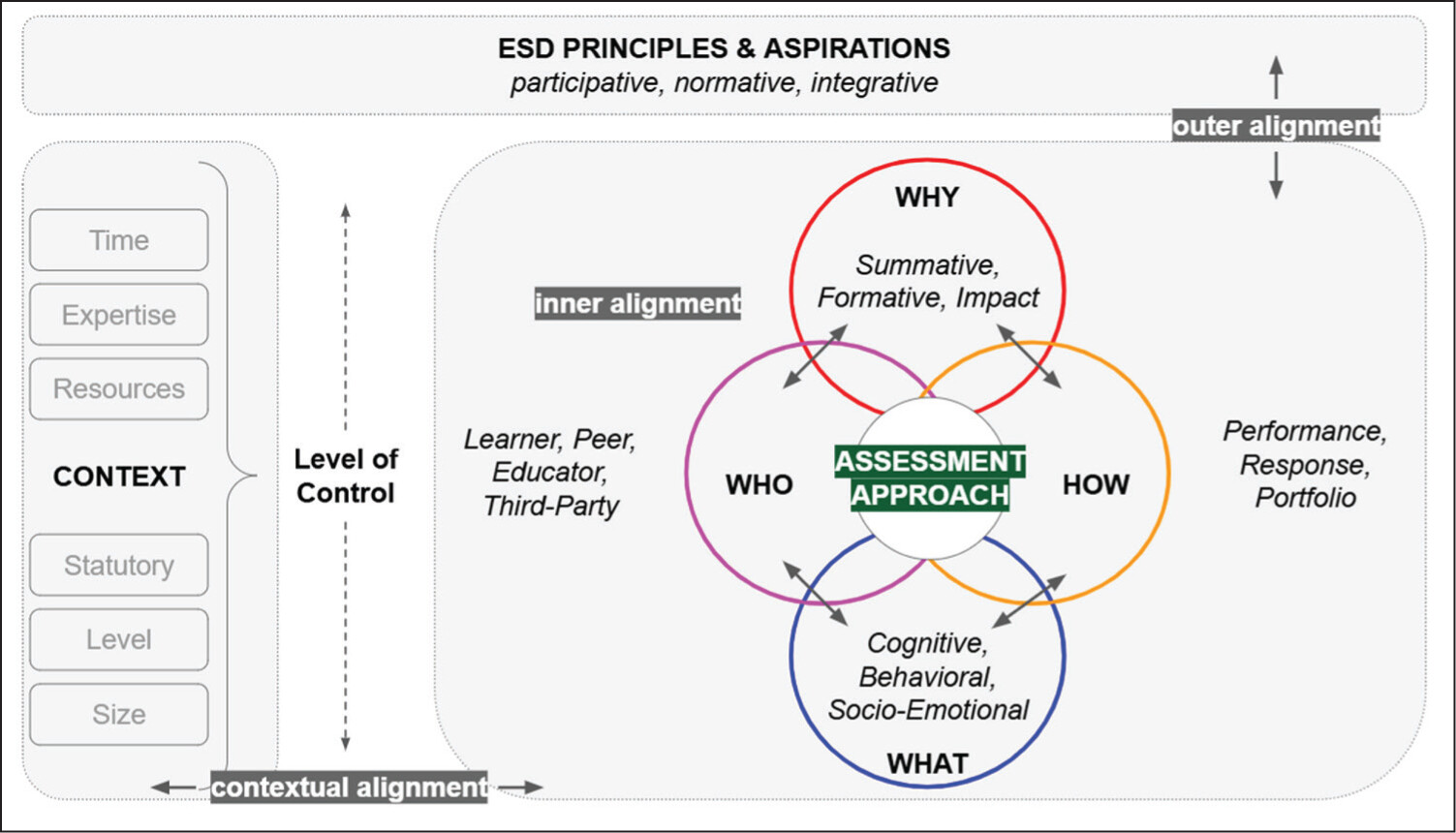
In response, the paper introduces the ESD Learning Assessment Framework (ESD-LAF), which centres on four design considerations — the WHY (purposes of assessment), the WHAT (learning outcomes to assess), the HOW (assessment approaches and designs), and the WHO (roles in the assessment process). What makes the framework distinctive is its emphasis on alignment: internally among the four considerations, and externally with ESD principles. A test-based assessment that claims to serve ESD goals but ignores learner agency, values, and real-world application fails on the outer alignment level — and the framework offers a practical way to diagnose and address exactly that kind of disconnect.
The commentary grew directly out of the work we have been doing with UNESCO as part of the Transforming Futures initiative. As commissioned consultants developing the guidance tool on ESD learning assessment — one of three toolkits produced under UNESCO's ESD for 2030 programme — we found that a theoretical synthesis of the field was needed alongside the practical tool. This paper provides that foundation: it frames the conceptual case that the toolkit then translates into actionable guidance for educators.
Paper Abstract:
The role of assessment in education for sustainable development (ESD) is in need of re-assessment. Despite its importance, assessment in ESD has been criticized for its detrimental effects on learner well-being, lack of innovation and failure to adequately consider fundamental sustainability principles, limiting its integral link to learning. A framework for ESD-sensitive assessments is proposed, considering the 'WHAT', 'HOW', 'WHO' and 'WHY' of assessment. This commentary argues that constructive alignment is needed not only between objectives, pedagogies and assessment, but also between these considerations of assessment and their alignment with general principles and aspirations of ESD. By rethinking assessment along these lines, and by grounding them in local contexts, ESD can contribute to its original task of reorienting quality education towards sustainable development. In light of this endeavour, the authors call for a more nuanced understanding of the purposes, methods, roles and objectives of ESD learning assessment, and how they can be aligned to better support ESD principles and aspirations.
Bibliographic reference:
Fischer, D., King, J., & Redman, A. (2025). Rethinking learning assessment in education for sustainable development: A call for action. Journal of Education for Sustainable Development, 19(1), 58–75. https://doi.org/10.1177/09734082251355050